
And the Final Round
Goes to … Argument Man

Nov|Dec 09 contents
Gazette Home
Search

Profiles : Events : Notes : Obituaries
Marie Savard Nu’70 GrNu’72 M’76 answers your health questions
Digital-image pioneer George E. Smith C’55 shares Nobel Prize
Scrap Kins creator Brian Yanish C’95 makes recycling fun
Jonathan Grabelle Herrmann W’00 runs “Campus Philly”
AKA Argument Man: Debate Team director Douglas Robbins L’01
Philanthropist Henry Baron W’41 helps children with challenges
Fitness guru Gina Lombardi DH’83 takes no excuses
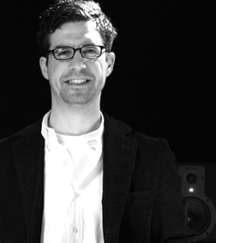
Class of ’01 | For
too many years of his life, audacious ambitions, combined with an
often-unhealthy obsession with arguing, stunted the psychic growth of
Douglas Robbins L’01.
Yet it was precisely those two qualities that spawned a work that has
exorcised many of the demons of his past while giving him a fresh
outlook for the future: an independent documentary film called Debate Team (www.debateteamdocumentary.com),
which Robbins produced, directed, and edited with little more than a
vague knowledge of filmmaking and a few maxed-out credit cards.
“I was unemployed and my vision for how my career would turn out had
crashed and burned,” admits Robbins, 38, who had been laid off from his
San Francisco law firm in 2003, shortly before he started work on Debate Team.
“The only real risk is the cash,” he says. “But you tell yourself, ‘For
$10,000, I can live my dream or buy a used car. What do you want to do
here?’”
The answer was simple. He would make a film about something that was
close to his heart: college debate tournaments and all the bizarre
quirks associated with them.
But to start the project, Robbins had to lie to himself, both about the
scope of the film and his chances for success. He told himself that the
film would be short and not very time-consuming. And if everything went
right, he reasoned, his documentary could be a critical success and
earn an Academy Award nomination, the same way Spellbound had a couple of years earlier.
“Realistically, your chances of winning an Academy Award are similar to
your chances of winning the lottery,” Robbins says. “But emotionally,
you think, someone has to get an Academy Award nomination. The fantasy keeps you moving at all times.”
Nine years earlier, Robbins had a similar fantasy. After graduating
from the University of California-Berkeley—where he participated on the
debate team—he spent the next six years heeding the words of the late
American writer and mythologist Joseph Campbell, “Follow your bliss.”
Robbins thought his own path to bliss would go something like this: Write a best-selling novel about debate. Go on Letterman. Be set for life.
“I never had an experience with rejection,” he says. “I never thought it would fail.”
But it did. His novel wasn’t published. The six years spent writing all
day and then working odd night jobs to make ends meet seemed like a
complete waste. Worse, he started to question what he was supposed to
do with his life.
“Maybe that wasn’t my bliss,” he says. “Maybe I should have been
growing a business. Maybe I should have joined the Peace Corps. Maybe I
should have found true love and had kids. It begins to shake your
foundation.”
Penn Law gave him a second life. In the summer of ’98, Robbins left his
family, friends, and life as a struggling novelist back on the West
Coast. He used his writing skills and debate acumen to make the Law
Review. And when he graduated, he got a high-paying job at a
prestigious firm back west.
But he never could shake that creative itch. More to the point, he
still needed to bury the demons that had haunted him ever since his
novel was rejected.
“He’s a very targeted man,” says Robbins’ sister, Erin, an associate producer on Debate Team. “When he sees something he wants to do, he just does it.”
When Robbins got laid off in 2003, it almost felt like a relief. He had
hated some of the mundanities of his job. He felt like a cog, a
glorified paralegal. And he didn’t even get a chance to do what he’s
always done best: arguing.
Even as a kid, arguing came naturally to Robbins. Some
of his earliest memories were of verbal clashes with his parents over
how long he could stay out and play, or whether or not he could use a
hammer. Long after those arguments had ended, he remembers returning to
his room and retracing the contours of what was said to prove to
himself, if nobody else, that he had won the debate.
In college, he earned the nickname Argument Man. It was also there that
he fell in love with competitive debate tournaments, where real-world
rules of politeness and etiquette are thrown out the window and the
only thing that matters is the content of your argument. “I found the
whole thing intoxicating,” he says.
So when, all of a sudden, his days and nights became free, he decided
to buy an expensive camera, learn Apple’s Final Cut Pro, go to a few
debate tournaments with his best friend and co-producer, Joseph
Walling, and then try to make a movie.
“We decided to do it first,” Robbins says, “and sort through the wreckage later.”
There was inevitably some wreckage along the way. For instance, Robbins
and Walling had to lie about their insurance policy—they didn’t have
one—to shoot their first tournament. And only later did they find out
that much of their material was unusable because of audio or focus
issues.
But after about three long years in post-production, Robbins finally
had his film, which premiered late last year at the San Francisco
International Documentary Film Festival and is currently available on
DVD.
The funny thing about the end product is how much it changed from
Robbins’ early vision. At first, he’d thought the film should be
crafted in the mold of The Karate Kid,
in which perseverance triumphs over adversity, the champion is bathed
in glory, and everyone lives happily ever after. But soon he began to
focus on some of the deeper—and spookier—parts of debate: how
competitors are trained to talk at a pace that’s incomprehensible to
most people, how the theme of planetary extinction surfaces in most
debates, and how winning means so much to some debaters that they’d say
they’d kill a puppy if it meant they wouldn’t lose.
Many of these themes resonated on a personal level with Argument Man,
who was once asked by a girlfriend: “Do you want to be right or do you
want to have friends?”
“There’s an underbelly to debate,” Robbins says. “It arguably
over-encourages the concept of intellectual domination above other
values. In the end, arguing is a good tool. But like any good tool, it
can be overused and it can end up causing pain.”
These days, Robbins isn’t feeling the same kind of pain he felt when he
was younger. Although his film failed to get any financial backing and
was rejected from all of the elite film festivals, he is glad he
produced an in-depth, semi-scathing portrait of an activity that has
shaped his life in such a profound way.
His Oscar dreams may have long since vanished—his main goal now is just
to break even on the project through online DVD sales—but that’s OK
with him.
“I’m never going to look back and say I didn’t even give it a shot,”
says Robbins, who now works at a small law firm where, he says, he can
actually practice the law. He also recently founded the Media Law
Group, which he hopes will help other independent filmmakers understand
the legalities of making their own film.
“I’ll never have those regrets,” he continues. “Now I’m dating a
beautiful girl; I’m happy with what I’m doing; and I made a documentary
that many people enjoy. At this point, I’m focusing on being happy with
who I am and less obsessed with what the American culture thinks I
should be.”
The tagline of Debate Team is “America loves a winner and will not tolerate a loser.”
Once, the director believed that.
—Dave Zeitlin C’03
Last modified 10/28/09